English
 中文简体
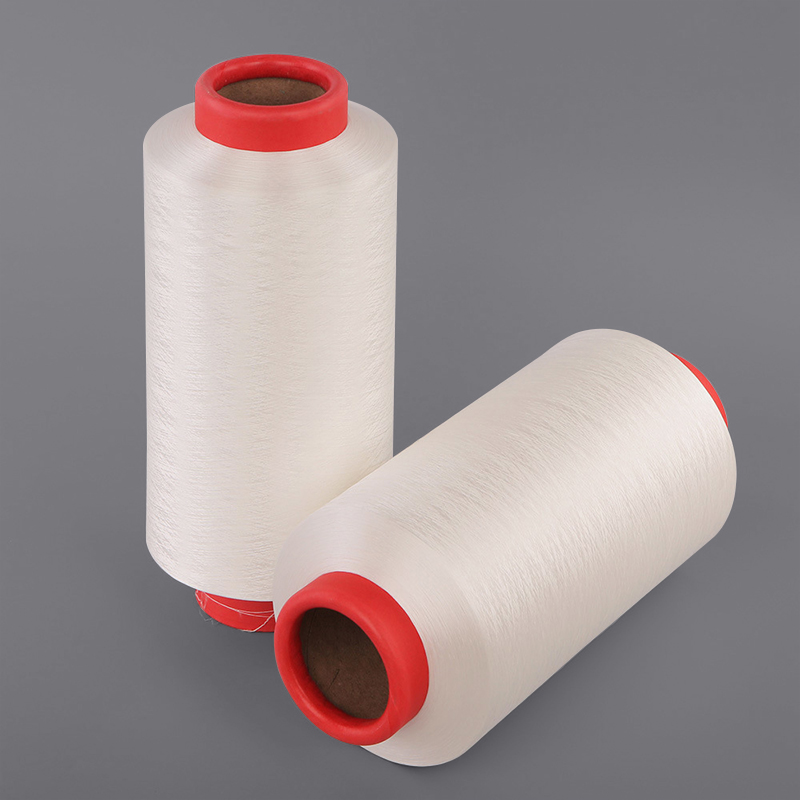
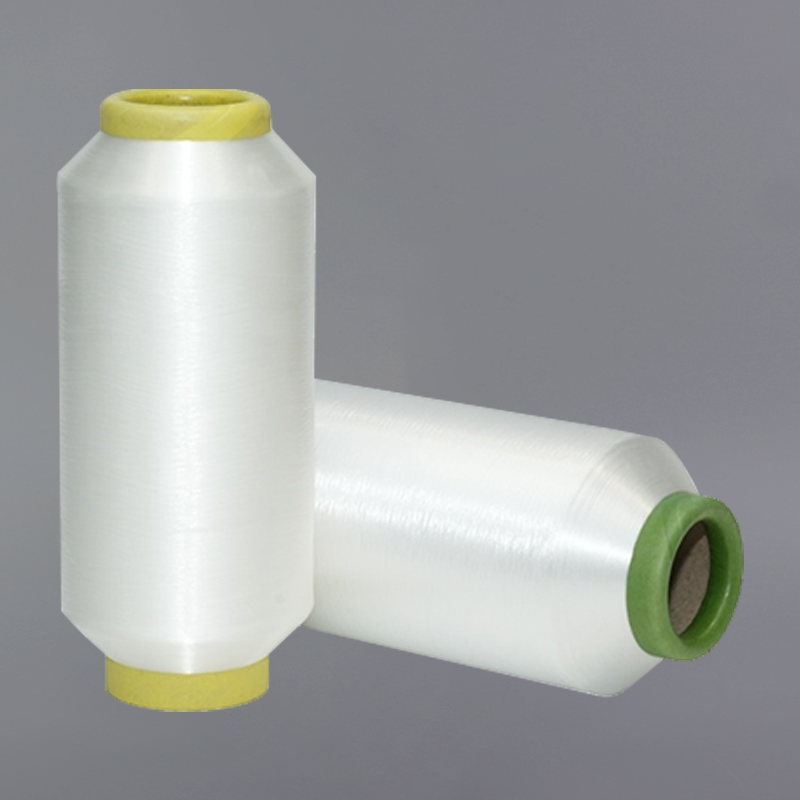
中文简体It is made with Bio-base PLA, fully biodegradable Feature: 1. Industrial compost product 2. Made with PLA 3. Eco-frie...
READ MORE
Content
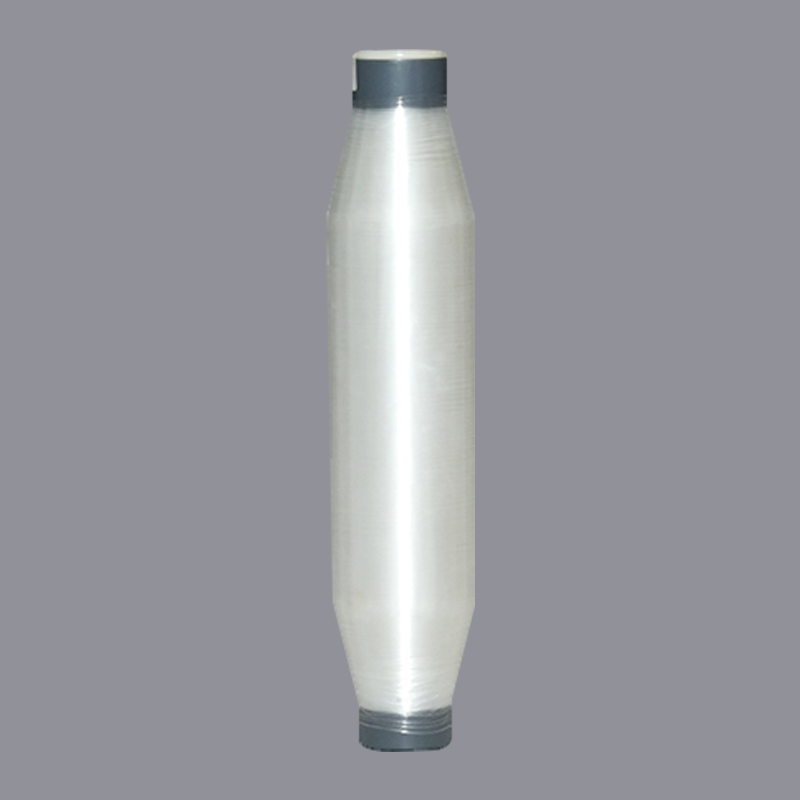
Modern textile manufacturing increasingly depends on materials that can combine strength, flexibility, processing efficiency, and reliable bonding performance. Conventional adhesive systems may provide strong adhesion, but they can also create problems such as stiffness, residue, uneven application, poor compatibility with polyester fabrics, and additional production steps. Sheath-core polyester low melting yarn at 110°C offers a practical alternative by integrating bonding capability directly into a continuous filament yarn.
This specialized bicomponent yarn is designed with a low melting polyester sheath surrounding a high-melting polyester core. When exposed to an appropriate heat-setting, hot-pressing, or steam treatment, the sheath softens and melts at approximately 110°C. The core remains structurally stable and continues to provide tensile strength, dimensional support, and processing stability. As a result, the yarn can bond with adjacent fibers or textile components without losing the mechanical integrity of the finished product.
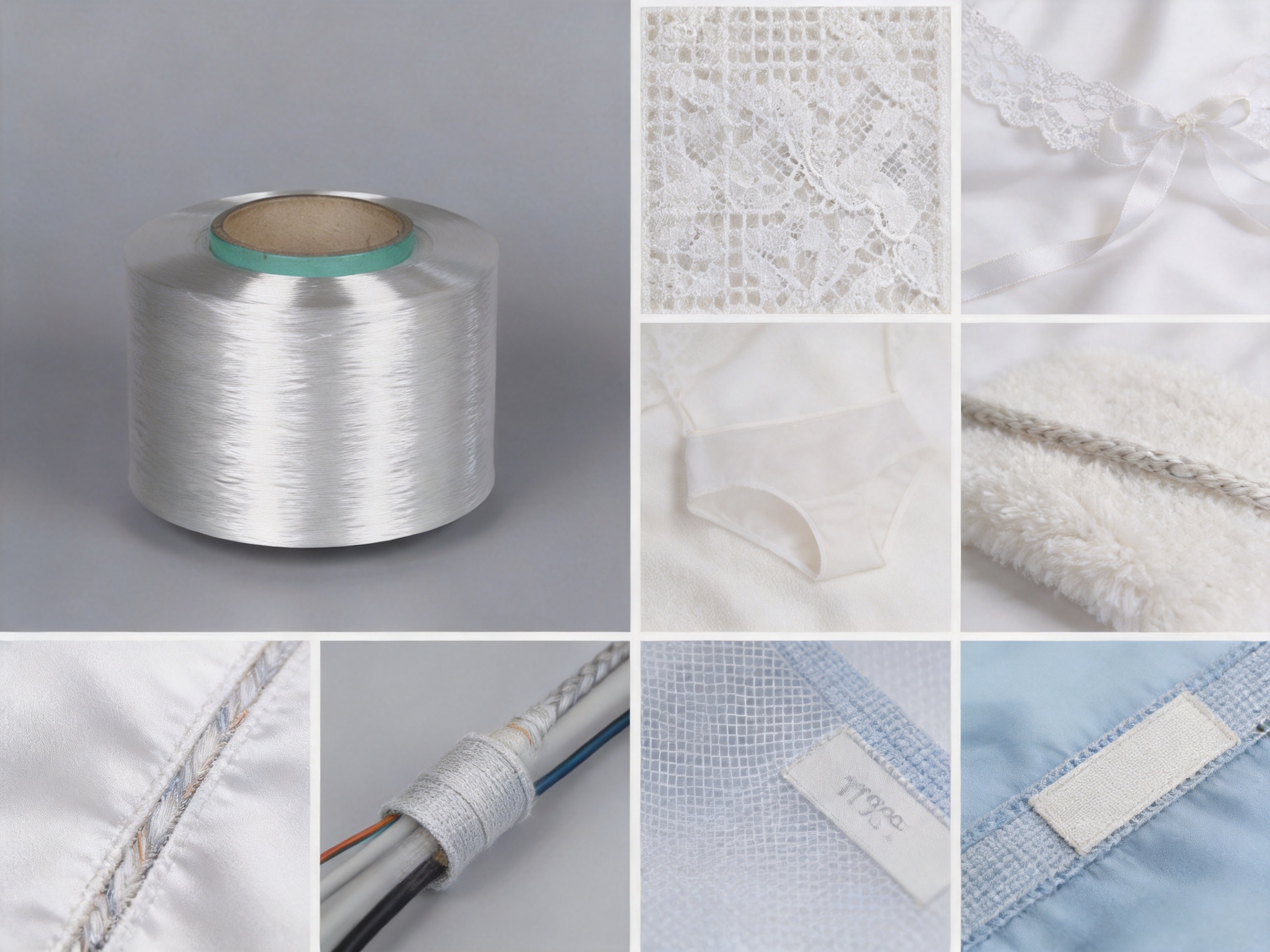
The product is available in 30D, 50D, and 70D specifications. These fine denier options are suitable for high-gauge knitting, delicate lace, lingerie ribbons, seamless underwear, three-dimensional knitted fabrics, chenille yarn, ropes, cable wire protection, and other technical applications. The combination of a fine linear density, high tenacity, easy rewinding, and controlled melting behavior enables manufacturers to produce lightweight textile structures with reliable bonding and a soft hand feel.
Produced by NanTong Global Chemical Fiber Co., Ltd., operating under the GC FIBER brand, this yarn reflects the company’s focus on special, functional, and eco-friendly textile materials. The manufacturer develops and produces multiple categories of advanced yarn, including biodegradable yarn, low melting yarn, ECDP yarn, anti-static yarn, HDPE yarn, bio-component yarn, and polyester filament yarn. This broad product base supports customized material development and allows the company to respond to changing requirements in apparel, home textiles, industrial fabrics, and technical textile markets.
Sheath-core polyester low melting yarn is a bicomponent filament yarn made from two polyester-based components arranged in a concentric cross-sectional structure. The outer component is the sheath, which is formulated to melt or soften at a relatively low temperature. The inner component is the core, which has a higher melting point and maintains its shape during the bonding process.
The sheath serves as the bonding agent. During heat treatment, it becomes soft and adhesive, allowing neighboring filaments, fibers, fabric layers, or textile components to connect. The core functions as the permanent reinforcement element. It remains intact and supports the bonded structure after cooling. This arrangement creates a balance between thermal bonding and mechanical performance that is difficult to achieve with a single-component yarn.
Unlike a separate liquid or film adhesive, the bonding material is already integrated into the yarn. This helps simplify production, improve application uniformity, and reduce the risk of excessive adhesive spreading. The yarn can be knitted, woven, wrapped, braided, or combined with other polyester materials before activation. Once the textile structure reaches the required thermal treatment conditions, the sheath provides localized bonding where the yarn has been incorporated.
The nominal activation or melting point of the product is 110°C. Actual processing conditions may vary according to fabric construction, machine design, heating method, dwell time, tension, pressure, and the type of neighboring material. Therefore, manufacturers should validate the exact temperature profile on their own equipment before full-scale production. The 110°C designation provides a practical reference for process planning, while production trials determine the optimum balance between bonding strength, softness, dimensional stability, and productivity.
The performance of the yarn begins with the controlled arrangement of the two polymer components during bicomponent extrusion. The high-melting core is positioned at the center of the filament, while the low-melting polymer forms a continuous outer layer. This structure must remain consistent along the length of the yarn so that the bonding response is predictable during downstream processing.
When the yarn is exposed to heat, the sheath reaches its softening and melting range before the core. The softened sheath flows sufficiently to create contact with adjacent fibers or textile surfaces. Under pressure, tension, steam, or controlled heat, it forms a bond as it cools. Because the core remains stable, the yarn does not completely collapse into a liquid adhesive. The finished textile therefore retains a reinforcing filament that contributes to strength and shape retention.
This mechanism provides a significant advantage over ordinary low melting yarns that may soften throughout their entire cross section. A fully meltable yarn can offer bonding, but excessive melting may reduce tensile strength, cause migration, or leave the finished area too stiff. The sheath-core design limits the melting function primarily to the outer layer and preserves the inner support element.
The structure also helps produce a more controlled bonding zone. Instead of applying adhesive separately and attempting to distribute it evenly, the textile manufacturer places the functional yarn precisely where bonding is needed. This can be especially valuable in narrow ribbons, lace, three-dimensional knitted structures, reinforcement channels, and small technical components where adhesive application would be difficult or wasteful.
After cooling, the bonded area can retain a combination of flexibility and stability. The exact result depends on yarn count, fabric density, bonding temperature, pressure, cooling rate, and the compatibility of the surrounding materials. Polyester-based construction gives the yarn broad compatibility with standard polyester filaments and other polyester textile components.
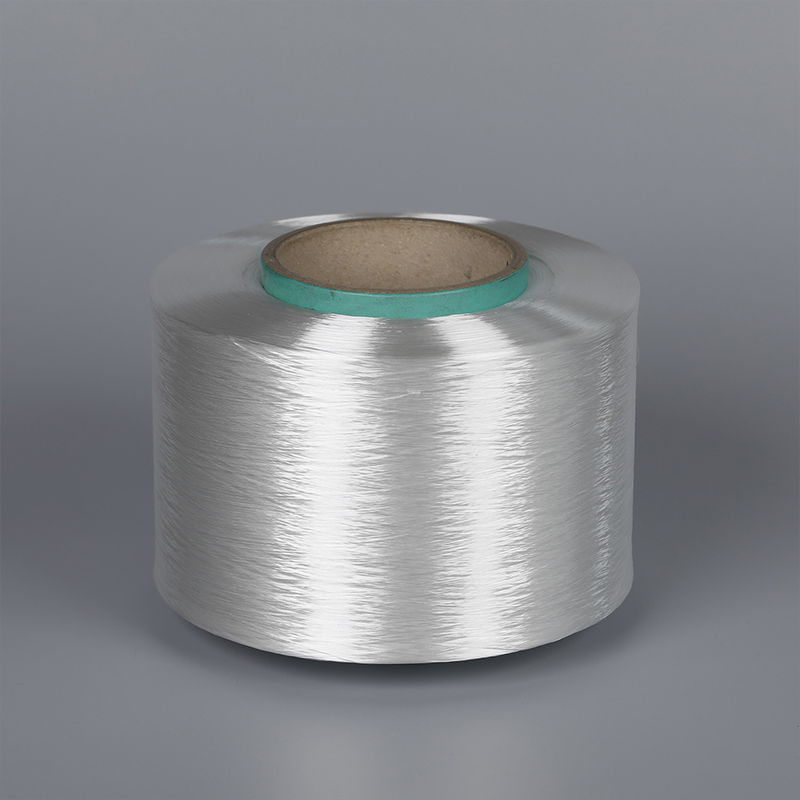
Sheath-Core Polyester Low Melting Yarn 110 Degree
The continuous polyester core gives the yarn a strong mechanical backbone. It allows the yarn to withstand the tension and handling associated with winding, knitting, weaving, braiding, and other textile operations. High tenacity is particularly important when the yarn is used in computerized flat knitting, warp knitting, narrow fabric production, and automated winding systems.
A yarn that breaks frequently can reduce machine efficiency, increase operator intervention, create fabric defects, and raise material waste. By retaining a stable core, this product is designed to pass through production equipment with fewer interruptions. The strong core also helps the yarn retain its reinforcing role after the sheath has been activated.
Easy rewinding supports stable preparation for downstream textile production. Consistent winding helps reduce tension variation, uneven package formation, and yarn delivery problems. This is important for fine denier yarns because small changes in tension can influence knitting uniformity, loop formation, fabric appearance, and bonding distribution.
Efficient rewinding also supports different customer requirements. Depending on the application, the yarn may be supplied in packages suitable for knitting machines, winding machines, narrow fabric equipment, or specialized production lines. Custom package and production requirements can be discussed with the manufacturer during order preparation.
The 110°C low melting point provides a practical bonding temperature for many textile processes. It allows bonding to occur at a lower temperature than would be required to melt ordinary high-melting polyester. This can help protect heat-sensitive fibers, trims, and fabric constructions from unnecessary thermal exposure.
Lower-temperature bonding may also support shorter heating cycles and more flexible equipment selection. Depending on the production line, activation can be achieved through dry heat, hot pressing, steam treatment, or another controlled thermal method. The process should be adjusted to ensure that the sheath melts sufficiently while the core and surrounding textiles remain stable.
The sheath-core cross section is the central technical feature of the product. The outer layer provides thermal adhesion, while the central core maintains strength. This design separates the bonding function from the structural function within one filament.
For textile manufacturers, this can eliminate the need to combine a conventional reinforcement yarn with a separately applied adhesive in some applications. It can also make the bonding location more precise because the adhesive function follows the path of the yarn. The result is a more integrated textile construction with fewer auxiliary materials.
The product is available in 30D, 50D, and 70D. Fine denier options are useful in applications where the yarn must provide bonding without adding substantial thickness, weight, or stiffness. This is especially relevant to lingerie, lace, lightweight mesh, seamless garments, sportswear, and high-gauge knitted products.
The 30D option may be considered for very delicate structures and applications requiring minimal visual or tactile impact. The 50D option offers a balance between fineness, handling, and bonding contribution. The 70D option provides a comparatively higher level of material presence and may be selected where additional support, durability, or handling stability is required. The correct option depends on the construction and performance targets of the finished product.
One of the primary advantages of sheath-core low melting yarn is that the adhesive function is integrated into the yarn itself. Traditional textile bonding may require liquid adhesives, adhesive films, powders, tapes, or additional coating operations. These methods can involve extra equipment, storage, application control, drying, and quality inspection.
With a low melting yarn, the bonding material is positioned during yarn formation and introduced into the textile structure through ordinary yarn processing. This can simplify production planning and reduce the number of separate materials required. It may also support cleaner, more repeatable application in narrow or complex textile areas.
Separate adhesives may migrate through fabric layers when exposed to heat and pressure. Excessive migration can create visible spots, hard areas, surface contamination, or changes in fabric hand. The sheath-core structure helps control the adhesive because the low-melting component is concentrated around the stable core rather than supplied as an unrestricted liquid.
Controlled melt flow is particularly valuable in delicate products. Lace, lingerie ribbons, translucent fabrics, and high-gauge knitted materials may reveal even small amounts of adhesive bleed-through. By using the bonding yarn in a planned position and applying suitable process conditions, manufacturers can reduce the likelihood of uncontrolled spreading.
Some adhesive systems produce a rigid bonding line that can compromise comfort and flexibility. This is a significant concern in underwear, intimate apparel, sportswear, and garments designed for direct skin contact. The fine denier sheath-core yarn is designed to provide bonding while preserving the flexibility of the textile construction.
The stable core supports the fabric without requiring a thick adhesive layer. When the correct yarn count and activation conditions are selected, the final structure can maintain a softer hand and a more natural drape than a heavily coated or laminated alternative.
Because both the sheath and core are polyester-based, the yarn is well suited to polyester fabrics and polyester filament systems. Compatibility can contribute to consistent processing behavior, similar thermal response, and coordinated dyeing performance when the yarn is used with suitable polyester materials.
Polyester compatibility is also useful when manufacturers need to integrate the bonding yarn into an existing polyester production line. It reduces the challenge of combining polymers with very different chemical or thermal characteristics. Nevertheless, testing remains important when the yarn is combined with nylon, elastane, natural fibers, coated textiles, or other non-polyester materials.
Liquid adhesives and other bonding systems can create sticky residues on rollers, guides, heating surfaces, presses, and machine components. These residues may require frequent cleaning and can contribute to downtime. A controlled yarn-based bonding method can reduce the amount of free adhesive present in the production environment.
The product information emphasizes reduced contamination and cleaner production. The actual maintenance benefit will depend on the application and process settings, but the principle is clear: a stable core helps retain the molten sheath around the yarn path and reduces uncontrolled adhesive leakage. This can support better equipment cleanliness and more predictable operation.
When an adhesive is applied separately, some material may be deposited outside the intended bonding area. A functional yarn places the bonding component directly into the textile construction. This can improve material utilization and reduce unnecessary coating or application losses.
Material efficiency is increasingly important for manufacturers seeking to control cost, simplify inventory, and improve environmental performance. Using a single multifunctional yarn in place of separate reinforcement and adhesive components may also reduce the number of production stages and simplify product assembly.
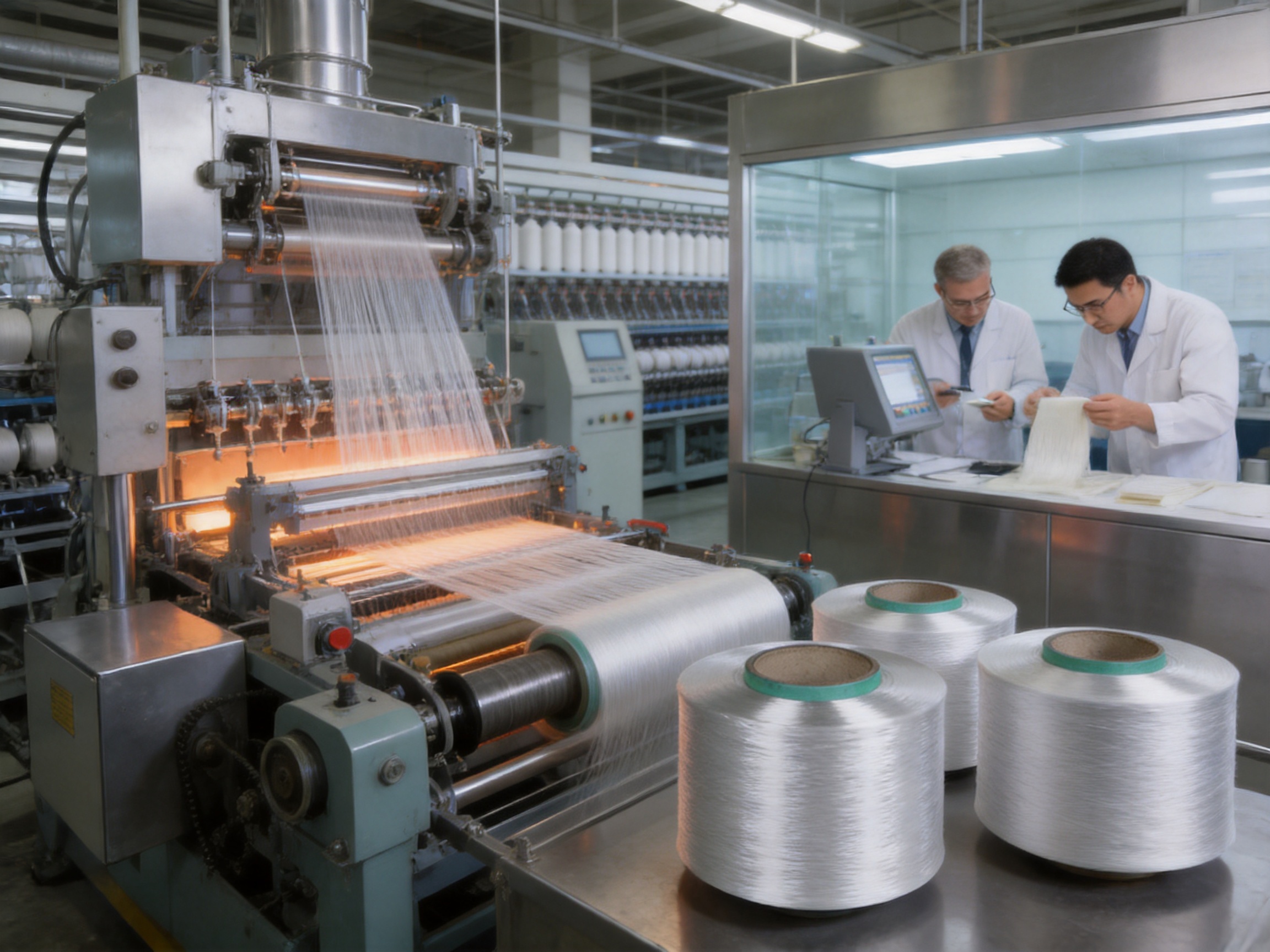
The quality of a sheath-core polyester low melting yarn depends on polymer formulation, extrusion precision, cross-sectional control, drawing, heat treatment, winding, inspection, and order management. As a special textile factory, GC FIBER combines research, development, production, and sales activities to support the complete product lifecycle.
The first stage is the selection and preparation of polyester polymers with different melting behaviors. The sheath must soften and melt at the target temperature, while the core must retain sufficient thermal stability and mechanical performance. The formulations must also be compatible enough to form a stable bicomponent filament during extrusion.
Material selection involves balancing melting point, viscosity, tenacity, elongation, thermal shrinkage, crystallization behavior, adhesion, and long-term stability. A sheath that melts too easily may create handling or storage challenges. A sheath that melts insufficiently may fail to generate reliable bonds. Similarly, the core must be strong enough to maintain yarn integrity without interfering with the thermal activation of the sheath.
Advanced bicomponent extrusion equipment combines the sheath and core polymers in a carefully controlled flow path. The two components are brought together in a sheath-core arrangement before passing through the spinneret. Spinneret design influences the diameter, concentricity, and continuity of the final filament.
Stable extrusion requires careful control of polymer temperature, pressure, throughput, viscosity, and residence time. Any significant fluctuation can affect the relative thickness of the sheath, the position of the core, or the uniformity of the filament. Consistent cross-sectional structure is essential because it determines how the yarn behaves during drawing and later thermal bonding.
During spinning, the extruded bicomponent stream is converted into continuous filaments. Cooling conditions must be controlled to solidify the filament without creating excessive internal stress or surface irregularity. Filament formation influences the yarn’s appearance, strength, friction, winding behavior, and downstream processability.
The manufacturing process must protect the low-melting sheath from premature deformation while ensuring that it remains continuous and firmly attached to the core. Proper control at this stage helps produce yarn that can be handled at ordinary processing conditions and activated only when the customer applies the intended thermal treatment.
Drawing aligns the polymer chains and improves the mechanical properties of the filament. The draw ratio, heating conditions, and tension profile must be selected according to the properties of both components. Excessive stress may damage the sheath or disturb the cross-sectional relationship. Insufficient orientation may reduce tenacity and dimensional stability.
A well-controlled drawing process contributes to the product’s high tenacity and easy rewinding. It also helps ensure that the yarn can pass through knitting needles, guides, feeders, and winding equipment without frequent breakage or excessive fuzz formation.
Heat treatment can be used to stabilize the yarn and manage thermal shrinkage. This step must be carefully differentiated from the customer’s final bonding process. The yarn should be stable enough for storage and downstream processing, while the sheath must retain its intended activation characteristics.
Thermal stabilization may influence package behavior, fabric dimensions, bonding strength, and post-treatment appearance. Process development therefore requires an understanding of how the yarn responds not only to the nominal 110°C melting point but also to heating rate, exposure time, pressure, and cooling conditions.
After spinning and treatment, the yarn is wound into packages suitable for transportation and customer processing. Precision winding helps maintain consistent yarn delivery and reduces the possibility of tangles, sloughing, collapsed edges, or excessive package hardness.
Fine denier yarn requires particular attention because a small filament diameter can make it more sensitive to tension variation and handling damage. Consistent winding supports reliable unwinding and contributes to the product’s easy-rewind characteristic.
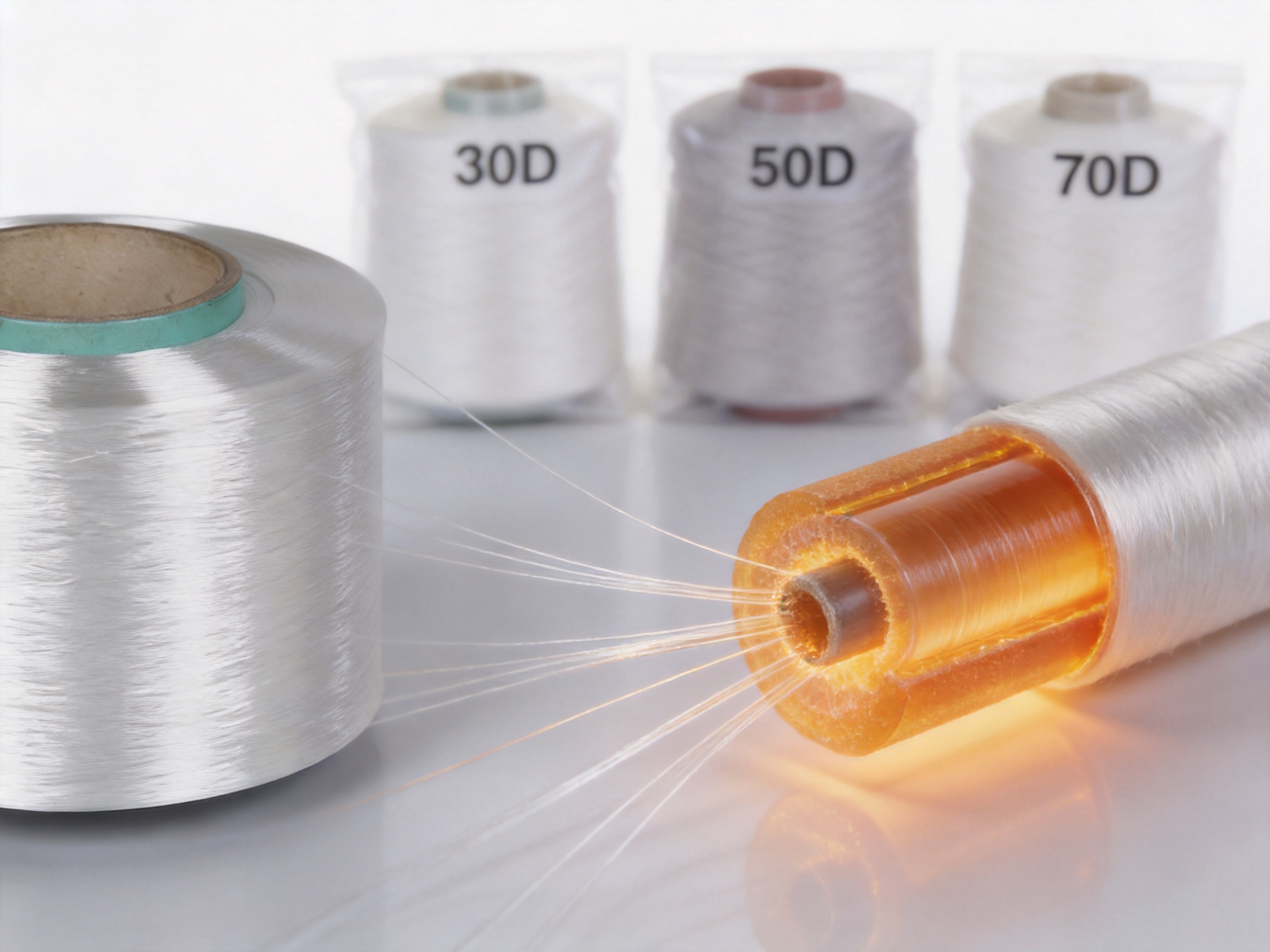
Quality control for functional yarn should address both ordinary yarn performance and thermal bonding performance. A product may have excellent tensile strength but fail to provide uniform activation, or it may melt effectively but suffer from poor winding behavior. A balanced evaluation system is therefore necessary.
Denier consistency is important for maintaining uniform fabric weight, appearance, and bonding contribution. Variations in linear density can produce differences in yarn coverage and thermal response. The 30D, 50D, and 70D specifications should be produced within controlled tolerances suitable for the customer’s application.
Tenacity testing measures the yarn’s resistance to breaking under tension. Elongation testing helps determine how the yarn behaves during knitting, weaving, winding, and fabric deformation. These properties influence machine performance and the durability of the final textile.
The high-melting core is especially important in this evaluation because it carries much of the mechanical load. Testing before and after thermal treatment can help determine how much of the original strength is retained after the sheath has been activated.
Differential scanning calorimetry, hot-stage observation, thermal shrinkage testing, and practical bonding trials may be used to assess thermal behavior. Laboratory data can identify the softening range and melting characteristics, while application trials demonstrate how the yarn behaves under actual production conditions.
Manufacturers should evaluate bonding strength, surface appearance, flexibility, peel resistance, wash resistance, and dimensional stability. Testing should be performed on the specific fabric combination and equipment that will be used in commercial production.
Microscopic cross-sectional inspection can confirm the sheath-core arrangement and help identify irregularities such as eccentricity, incomplete coverage, voids, or uneven component distribution. A concentric and continuous sheath is important for consistent bonding performance along the length of the yarn.
Winding quality can be evaluated by checking package hardness, edge formation, yarn tension, unwinding smoothness, and the occurrence of knots or interruptions. These tests are particularly relevant to fine denier yarn intended for automated machinery.
Application trials provide the most useful information for customers. A yarn used in a 3D knitted fabric may require different conditions from a yarn used in a lingerie ribbon or a cable wire sleeve. Testing should replicate the intended construction, heat source, pressure, dwell time, cooling process, and finishing conditions.
Three-dimensional knitted fabrics require carefully controlled structural zones. Some areas must remain open and flexible, while others need reinforcement or shape retention. Sheath-core low melting yarn can be knitted into selected areas and activated to stabilize the structure after knitting.
In 3D footwear uppers, the yarn may help reinforce heel counters, lace zones, edges, or other load-bearing sections. It can also support the dimensional stability of breathable spacer structures without completely filling the open spaces that provide ventilation.
Chenille yarn production depends on securing fibers around a central structure. A low melting bonding yarn can help stabilize selected components and reduce the risk of fiber displacement or unraveling. The fine denier options are useful when the manufacturer wants to preserve the soft, full appearance associated with chenille while adding controlled structural support.
Delicate ribbons and lace often require a combination of softness, flexibility, edge stability, and resistance to fraying. A heavy adhesive coating may compromise comfort and visual quality. Fine sheath-core yarn can be incorporated into narrow bands or lace structures to create localized bonding and improve edge integrity.
The low activation temperature may also be helpful when the surrounding textile contains sensitive decorative elements. Process trials remain necessary to confirm that the selected temperature does not affect dyes, elastic components, coatings, or other trims.
Seamless underwear demands a smooth hand feel and minimal bulk. Bonding yarn can support the formation of stable edges, channels, decorative sections, and structural transitions without relying exclusively on thick sewn seams or visible adhesive tapes.
The stable polyester core provides reinforcement, while the fine denier construction helps preserve comfort. When integrated into a suitable knitting pattern, the yarn can contribute to a cleaner appearance and reduced risk of unraveling.
In fine ropes, narrow bands, and braided products, thermal bonding can help stabilize the arrangement of filaments and improve resistance to movement between components. The 70D option may be considered where additional yarn presence and support are required, while finer options may be selected for lightweight constructions.
The appropriate design depends on the rope structure, load requirements, number of yarns, activation method, and intended environment. For outdoor or safety-critical applications, customers should conduct full mechanical, environmental, and aging evaluations.
Heat-sealable textile sleeves can benefit from a yarn that provides localized bonding around or within the protective structure. Sheath-core polyester low melting yarn may assist with securing textile layers, closing narrow sleeves, or improving resistance to fraying at cut edges.
Because the yarn itself is not a substitute for electrical insulation or certified protective materials, cable applications must be evaluated according to the relevant electrical, thermal, mechanical, and regulatory requirements.
Fine industrial screens and filtration structures may require stable fiber positioning and controlled edge bonding. The yarn can help secure selected areas while maintaining a lightweight construction. The suitability of the product will depend on filtration efficiency, chemical exposure, temperature, pressure, cleaning method, and long-term durability requirements.
Labels, elastic narrow bands, garment tapes, and other narrow woven products often require clean edges and resistance to fraying. A low melting yarn can be integrated into the construction and activated to secure the edge or stabilize specific zones. This may help reduce the need for additional coating or cutting treatments.
| Yarn specification | General characteristics | Potential application direction |
|---|---|---|
| 30D | Very fine, lightweight, and suitable for low-bulk constructions | Delicate lace, lingerie, translucent ribbons, high-gauge knitting, and lightweight mesh |
| 50D | Balanced fineness, handling, and structural contribution | Seamless underwear, 3D knitted fabric, narrow bands, and general technical textile bonding |
| 70D | Higher yarn presence and comparatively stronger support | Reinforced knitted zones, ropes, cable wire sleeves, chenille structures, and durable narrow products |
The denier selection should be based on the final textile design rather than on yarn strength alone. A finer yarn may be the best choice when appearance, flexibility, and comfort are the highest priorities. A heavier option may be better when the textile must withstand greater tension or requires a more noticeable reinforcing element.
Fabric density also influences the choice. In a dense, high-gauge construction, 30D or 50D yarn may provide adequate bonding with minimal bulk. In a more open or mechanically demanding structure, 70D may offer better handling and reinforcement. Customers should compare the options through sample knitting, weaving, or braiding trials before confirming a production specification.
The recommended thermal process depends on the equipment and textile construction. Dry heat, steam, hot pressing, and other controlled methods may be used, but the temperature should be applied gradually and uniformly. Excessive heat or extended dwell time can cause unwanted deformation, excessive sheath flow, fabric glazing, or changes in hand feel.
Pressure can help the molten sheath contact neighboring fibers, but excessive pressure may flatten the textile structure or force the polymer beyond the intended bonding area. A balanced pressure level should be established through trials.
Cooling is also important. The bonded area should be allowed to stabilize under suitable tension and positioning conditions. Premature movement during cooling may weaken the bond or cause distortion. For three-dimensional structures, fixtures or controlled supports may be useful during the initial cooling stage.
Storage should protect the yarn from excessive heat, direct sunlight, moisture, contamination, and mechanical damage. Packages should remain stable and should not be exposed to conditions that could prematurely soften or deform the low-melting sheath.
Before mass production, customers should test:
1. Yarn feeding and unwinding performance.
2. Bonding temperature and heating time.
3. Fabric appearance before and after activation.
4. Bonding strength and flexibility.
5. Dimensional stability after cooling.
6. Resistance to washing, abrasion, and repeated deformation.
7. Compatibility with dyes, coatings, elastomers, and other textile components.
Functional yarn is more demanding than ordinary commodity filament yarn because its performance depends on multiple properties working together. A supplier must understand polymer behavior, bicomponent spinning, textile processing, thermal activation, and the customer’s final application.
GC FIBER has operated as a special textile factory in China since 2006. Its activities include research, development, production, and sales of functional and eco-friendly textile products. This integrated capability supports faster communication between product development and manufacturing teams.
The company’s product portfolio includes biodegradable yarn, low melting yarn, ECDP yarn, anti-static yarn, HDPE yarn, bio-component yarn, and polyester filament yarn. Experience across these categories provides a broader understanding of how different fibers behave in knitting, weaving, dyeing, heat treatment, and technical textile production.
A diversified product portfolio also supports material combination projects. A customer may require a low melting yarn together with a standard polyester filament, an anti-static component, an environmentally oriented fiber, or a high-strength technical yarn. A manufacturer familiar with multiple functional categories can help evaluate the interaction between these materials.
Research and development is another important strength. Textile customers frequently need modifications in denier, melting behavior, package format, color, cross-sectional design, mechanical properties, or application performance. The product is available in standard 30D, 50D, and 70D counts, while special production by order is also available for qualified requirements.
Custom production should begin with a detailed technical discussion. Customers should provide information about the intended machine, fabric structure, activation method, target bonding strength, final hand feel, color requirements, package size, order quantity, and relevant compliance standards. This information helps the supplier determine whether the standard product is suitable or whether a tailored development is necessary.
Functional performance and environmental responsibility are increasingly connected in textile manufacturing. A yarn that simplifies processing, reduces adhesive waste, and supports longer product life may contribute to more efficient production. The sheath-core design can reduce the need for separate adhesive materials in suitable applications and may help streamline the manufacturing sequence.
Polyester-based materials also offer established recycling pathways in some textile systems. However, the recyclability of a finished product depends on its complete composition, dyes, coatings, blends, and local recycling infrastructure. Customers should assess the entire product rather than assuming that a single polyester component determines final recyclability.
GC FIBER’s broader focus includes biodegradable yarn and bio-component yarn, reflecting an interest in developing materials aligned with sustainability goals. Different applications require different environmental solutions. A low melting yarn may be selected for process efficiency and integrated bonding, while biodegradable or bio-based yarns may be selected for end-of-life or renewable-content objectives.
Manufacturers should request relevant technical documentation when environmental claims are important. This may include polymer information, restricted substance declarations, production quality documents, test reports, and details about any applicable certification. Clear documentation helps customers make responsible material decisions and communicate accurately with their own buyers.
The main competitive strength of sheath-core polyester low melting yarn is its combination of bonding and reinforcement in one fine filament. Many conventional solutions provide only one of these functions. A separate adhesive may bond effectively but offer no tensile reinforcement. A standard polyester yarn may provide strength but cannot create a thermal bond at 110°C.
The bicomponent structure addresses both needs. The sheath supplies a localized bonding effect, and the core maintains a durable filament framework. This can reduce the need for multiple materials and can make the production process more compact.
The product also competes favorably in applications where softness and appearance are important. Its 30D, 50D, and 70D options allow manufacturers to select a suitable level of material presence. Fine denier construction can help prevent the bulky or rigid feel sometimes associated with adhesive films, thick coatings, or heavier bonding yarns.
Another competitive advantage is polyester compatibility. Polyester remains one of the most widely used fibers in apparel, home textiles, and technical fabrics. A polyester-based low melting yarn can be integrated into polyester systems without introducing a completely different fiber family.
Production stability is equally important. High tenacity and easy rewinding help reduce machine stoppages and improve the consistency of downstream processing. For customers operating automated equipment, reliable yarn delivery can be as important as the nominal melting temperature.
Successful use of this product should be treated as a collaborative development process. The yarn is a functional component, and its performance is influenced by the design of the entire textile system. A customer may need to adjust knitting density, yarn placement, heating profile, pressure, or cooling conditions to achieve the desired result.
Initial development may begin with small samples in all three available counts. The customer can compare surface appearance, flexibility, bonding strength, dimensional stability, and machine behavior. If the standard specifications do not meet the requirement, special production by order may be considered.
For a new application, the following information is useful:
1. The identity and composition of the surrounding fibers.
2. The intended textile construction.
3. The production machine and yarn feeding system.
4. The desired bonding area and bonding strength.
5. The available heating equipment.
6. The required softness, stretch, and recovery.
7. The expected washing, abrasion, chemical, and environmental exposure.
8. The target order quantity and delivery schedule.
9. Any testing, certification, or restricted-substance requirements.
Detailed communication at the beginning can reduce trial-and-error and help identify the most appropriate yarn count and process conditions.
The product is designed with a low-melting sheath that activates at approximately 110°C. The exact processing window depends on heating method, dwell time, pressure, fabric construction, and equipment. Customers should conduct application trials to establish the optimum production settings.
No. The yarn has a sheath-core structure. The outer sheath is the low-melting component and provides the bonding function, while the high-melting polyester core remains substantially intact and supplies mechanical support.
The standard available counts are 30D, 50D, and 70D. These specifications cover fine, lightweight, and comparatively more supportive applications. Special production by order may be discussed when a customer requires a different specification or package arrangement.
Yes. Its polyester-based construction makes it particularly suitable for integration with standard polyester filaments and polyester fabrics. Compatibility should still be confirmed through production trials, especially when dyes, coatings, elastane, nylon, or other polymers are present.
The product information identifies steam and dry heat as possible activation methods. The best method depends on the textile structure and equipment. Steam pressure, moisture level, exposure time, and cooling conditions should be optimized to achieve bonding without distortion.
The sheath-core design is intended to provide bonding while retaining the support and flexibility of the core. Final softness depends on yarn count, quantity used, fabric density, melt flow, pressure, and thermal conditions. Fine denier options may be preferred when a soft hand feel is important.
Yes. Lingerie ribbons, lace, seamless underwear, invisible channels, and delicate narrow structures are among the intended application areas. The 30D or 50D options may be considered for lightweight and comfort-focused designs, subject to testing for skin contact, washing, stretch, and durability requirements.
Yes. The yarn can be used to reinforce selected zones, stabilize edges, or support structural transitions in 3D knitted fabrics. It may also be useful in lightweight flyknit shoe uppers and breathable mesh products.
Special production by order is available for suitable requirements. Customization should be discussed in advance because the feasibility depends on material selection, denier, thermal behavior, color, package format, minimum quantity, and production scheduling.
Shanghai seaport is identified as the shipping port. Final logistics arrangements, packaging, documentation, and delivery terms should be confirmed during order negotiation.
Selection should consider fabric weight, desired bonding strength, flexibility, machine behavior, and the required level of reinforcement. Thirty denier is suitable for very fine structures, 50D provides a balanced option, and 70D may be appropriate where more support and material presence are required.
This product is a polyester-based low melting yarn and should not automatically be described as biodegradable. GC FIBER also offers biodegradable yarn and bio-component yarn as separate product categories. Customers seeking a specific environmental profile should request detailed material information and relevant documentation.
Customers should evaluate yarn feeding, rewinding, tensile performance, activation temperature, bonding strength, flexibility, appearance, dimensional stability, washing resistance, abrasion resistance, and compatibility with other materials. Testing should be performed using the actual machine and fabric construction whenever possible.
When purchasing functional yarn, the lowest unit price should not be the only consideration. Total production value also depends on breakage rate, machine efficiency, adhesive consumption, cleaning frequency, defect reduction, and finished-product performance. A yarn that provides stable processing and reduces separate bonding operations may deliver greater value over the complete manufacturing cycle.
Customers should request a technical data sheet, sample package, recommended processing guidance, and available quality documentation. For new applications, a sample order can help confirm whether the yarn meets the required mechanical and thermal targets before a larger commitment is made.
Communication should also cover delivery requirements. Shanghai seaport is available for shipping, while production lead time depends on count, quantity, package specification, customization, and current manufacturing schedules. Early confirmation is recommended for special orders or large-volume programs.
GC FIBER’s location in Haian, Nantong City, Jiangsu Province, provides access to China’s developed textile manufacturing network and logistics infrastructure. The company’s address is No. 66 Qiaogang Road, Haian, Nantong City, Jiangsu Province, China. Customers can contact the company through its service email for product inquiries, samples, technical discussions, and customized development.
Sheath-core polyester low melting yarn at 110°C is a functional textile material designed to combine controlled thermal bonding with continuous-filament strength. Its low-melting outer sheath acts as an integrated bonding agent, while the high-melting polyester core remains stable and provides lasting mechanical support.
The product offers several advantages over conventional single-component yarns and separate adhesive systems. These include high tenacity, easy rewinding, fine denier options, polyester compatibility, reduced adhesive migration, cleaner processing, controlled bonding, and the possibility of reducing additional adhesive operations.
Its applications extend across 3D knitted fabric, chenille yarn, lingerie ribbons, lace, seamless underwear, narrow fabrics, ropes, cable wire sleeves, filtration structures, woven labels, and other technical textile products. The available 30D, 50D, and 70D counts give manufacturers flexibility when balancing softness, weight, strength, and structural support.
The performance of the yarn is supported by bicomponent extrusion technology, controlled spinning, drawing, heat stabilization, precision winding, and application-focused quality control. NanTong Global Chemical Fiber Co., Ltd., operating as GC FIBER, combines manufacturing with research and development and maintains a broader portfolio of special and eco-friendly yarns. This enables the company to serve standard product requirements as well as customized material development projects.
For textile manufacturers seeking an efficient and integrated bonding solution, this sheath-core polyester low melting yarn provides a strong foundation for product innovation. Proper count selection, process optimization, and application testing will allow customers to obtain the best balance of bonding strength, flexibility, appearance, durability, and production efficiency.
1. Manufacturer product information for Sheath-Core Polyester Low Melting Yarn 110 Degree.
2. Manufacturer technical information on 30D, 50D, and 70D functional yarn specifications.
3. General principles of bicomponent fiber extrusion and sheath-core filament formation.
4. General textile testing practices for yarn tenacity, elongation, denier uniformity, winding performance, and thermal behavior.
5. General processing principles for thermally bonded textile structures.
6. Technical guidance concerning polyester filament yarn compatibility, heat setting, and dimensional stability.
7. General sustainability considerations for polyester-based functional textile materials and eco-oriented yarn development.
It is made with Bio-base PLA, fully biodegradable Feature: 1. Industrial compost product 2. Made with PLA 3. Eco-frie...
READ MOREPlease fill out the form below and our team will contact you as soon as possible.
Addres: No.66 Qiaogang Road, Haian, Nantong City, Jiangsu Province, China
E-mail: service@gcfiber.com admin@gcfiber.com
Copyright ? GC FIBER All Rights Reserved. Eco-Friendly Textile Products Manufacturer Biodegradable Yarn Company