English
 中文简体
中文简体It is made with Bio-base PLA, fully biodegradable Feature: 1. Industrial compost product 2. Made with PLA 3. Eco-frie...
READ MORE
Content
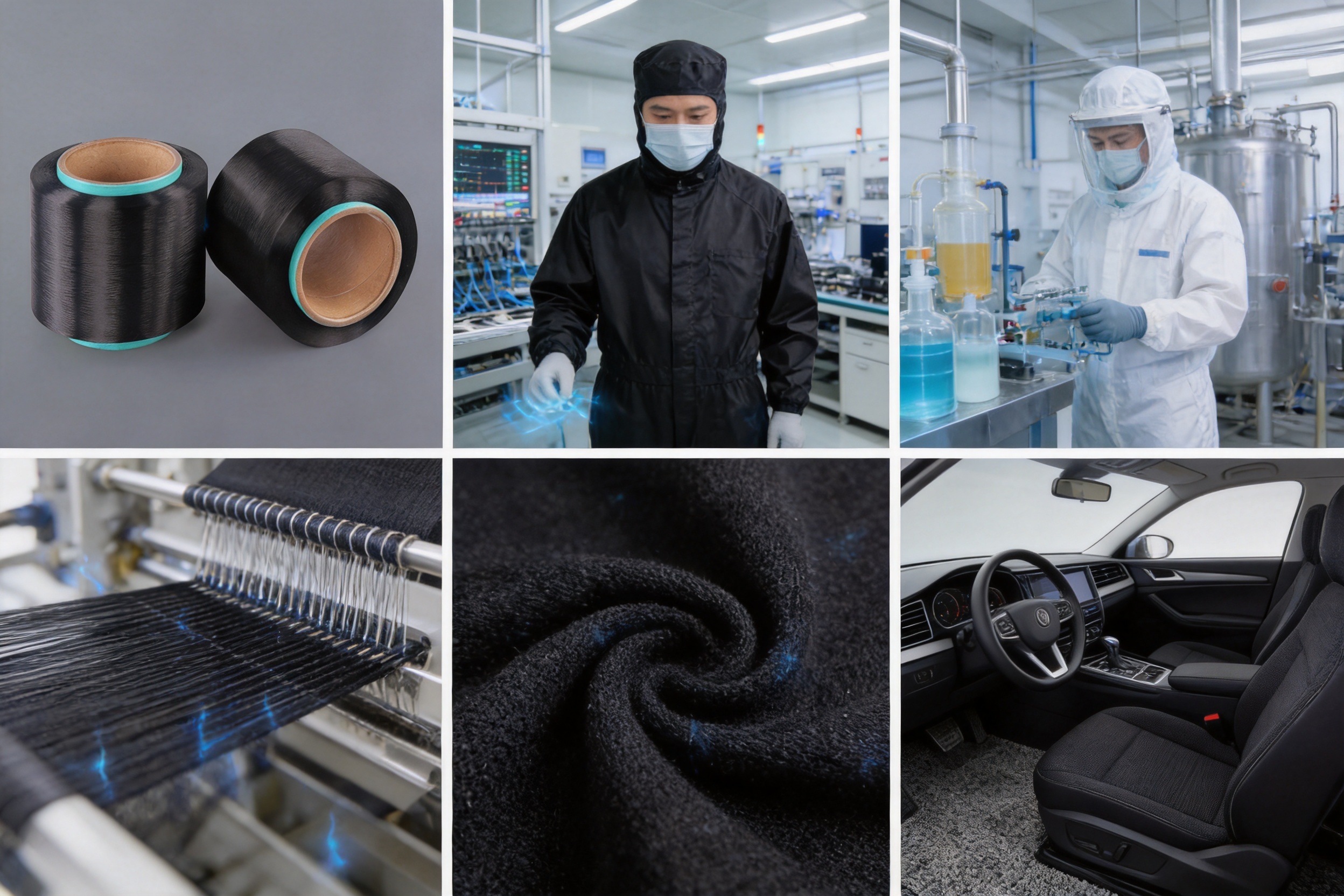
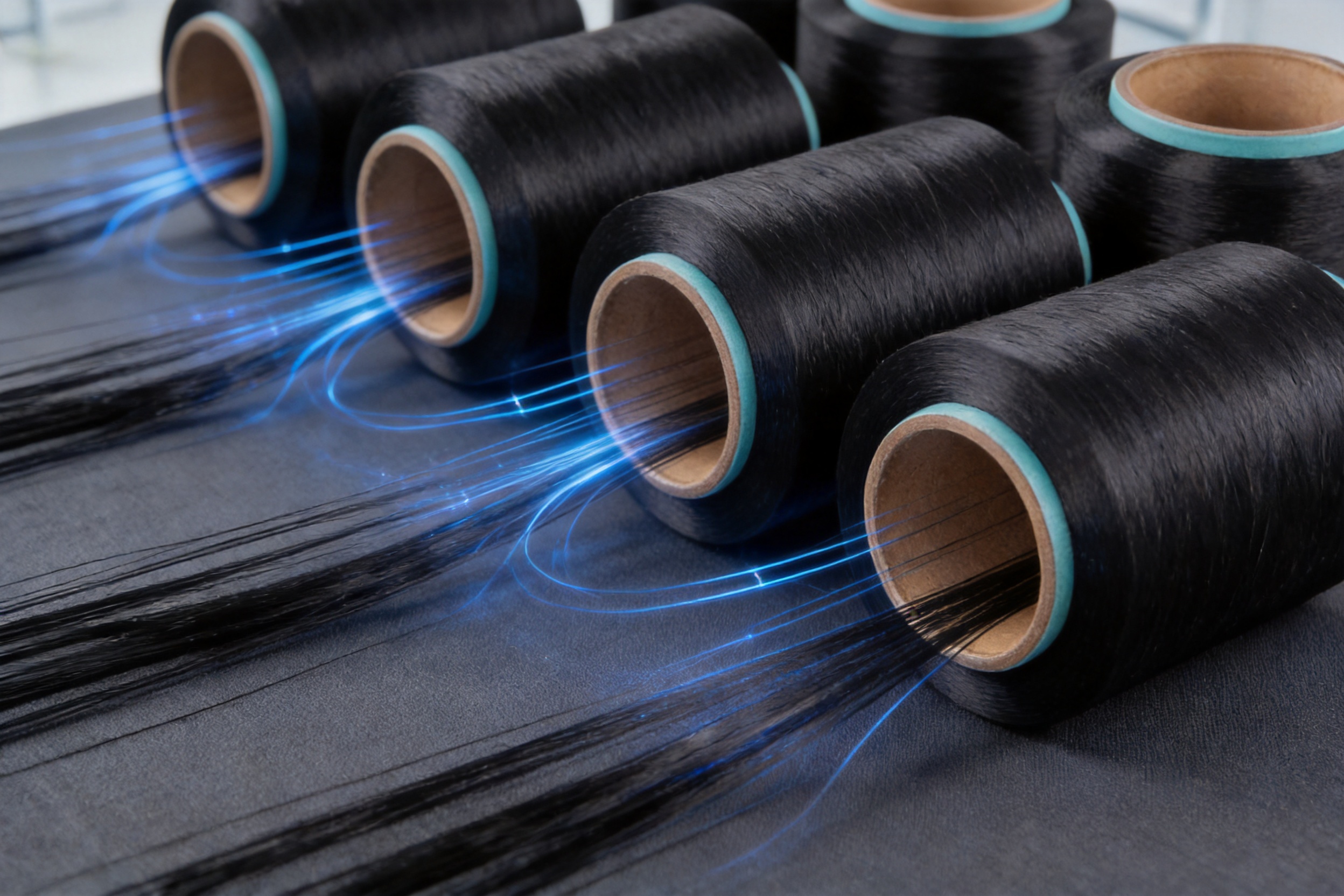
Anti-static polyester yarn black is a functional textile material developed for applications where ordinary polyester is not sufficient to control electrostatic charge. Combining the strength, dimensional stability, and processing convenience of polyester with a low resistance value, this yarn helps reduce static accumulation in garments, protective fabrics, industrial textiles, automotive interiors, carpets, and other woven or knitted products.
The yarn is manufactured as fully drawn yarn, or FDY, and is available in regular counts of 20D, 40D, and 60D. Special deniers can also be produced according to customer requirements. The black yarn has a stated resistance value of 10⁶ Ω/cm, providing a practical basis for static suppression in textile structures designed for electrostatic control.
Unlike basic polyester yarn, which can generate and retain static charge because of its relatively low moisture regain, anti-static polyester yarn is engineered to reduce the resistance of the fiber and improve the dissipation of electrical charge. This makes it suitable for environments where static electricity can create discomfort, attract dust, interfere with sensitive equipment, or increase operational risk.
The product is supplied by GC FIBER, a special textile manufacturer based in Jiangsu, China. The company develops and produces functional and environmentally oriented textile materials, including anti-static yarn, biodegradable yarn, low melting yarn, ECDP yarn, HDPE yarn, biocomponent yarn, and polyester filament yarn. Its experience in special fiber development supports the production of yarns designed for specific performance requirements rather than general-purpose textile use alone.
Static electricity is created when two surfaces come into contact, separate, or rub against one another. During textile processing and daily use, yarns may experience repeated friction with other fibers, machinery, skin, packaging materials, or surrounding surfaces. If electrical charge cannot move away efficiently, it accumulates on the textile.
Polyester is widely valued for its high tensile strength, abrasion resistance, dimensional stability, color retention, and easy-care properties. However, conventional polyester has limited moisture absorption. In dry conditions, this characteristic can make static charge more noticeable. The resulting effects may include fabric cling, crackling sounds, dust attraction, unpleasant shocks, and interference with sensitive production environments.
Anti-static polyester yarn black addresses this challenge through specialized fiber treatment and functional formulation. The goal is to create a yarn with a lower resistance value than ordinary polyester, allowing accumulated charge to be suppressed or dissipated more effectively. The yarn remains compatible with common textile manufacturing processes while providing an additional functional property.
Because it is produced as FDY, the yarn is fully drawn during spinning and drawing. This gives the filament a consistent structure and helps it perform smoothly during weaving, knitting, warping, and other textile processes. FDY is commonly selected when manufacturers need a continuous filament yarn with good uniformity, stable elongation behavior, and a clean surface.
The black appearance is produced as an integral product characteristic rather than being treated merely as an afterthought. Black is widely used in industrial clothing, uniforms, automotive textiles, technical fabrics, carpets, and interior products because it provides a professional appearance and can help conceal ordinary service marks. The black color also supports product identification in applications where anti-static yarn needs to be distinguished from standard yarn.
| Item | Specification |
|---|---|
| Product type | Anti-static polyester yarn |
| Yarn form | FDY, or fully drawn yarn |
| Color | Black |
| Regular counts | 20D, 40D, and 60D |
| Special counts | Customizable upon request |
| Resistance value | 10⁶ Ω/cm for black yarn |
| Production mode | Standard production and special production by order |
| Shipping port | Shanghai Port, China |
| Primary material | Polyester filament fiber with anti-static functionality |
The stated specifications provide a starting point for fabric development, but the final electrical performance of a finished textile can also depend on fabric construction, yarn blending ratio, finishing conditions, test method, temperature, humidity, and end-use design. Customers should therefore evaluate the yarn in the intended fabric structure before large-scale production.
The main performance objective of anti-static yarn is to reduce the tendency of a textile to accumulate charge. A lower resistance value enables charge to move through the yarn structure more readily than it would through a conventional insulating fiber. This does not mean that the yarn replaces a complete grounding system or eliminates every possible electrostatic event. Instead, it functions as an important material component in a broader static-control strategy.
When anti-static yarn is incorporated into a fabric, the yarn can form conductive or dissipative pathways through selected areas of the textile. Depending on the fabric design, it may be used throughout the structure or blended with standard polyester, nylon, cotton, or other fibers. The appropriate placement and percentage should be determined by the required surface resistance, charge decay, garment design, and applicable industry standards.
The black yarn has a resistance value of 10⁶ Ω/cm. This relatively low resistance is one of the product’s primary selling points. It gives textile manufacturers a measurable specification for material selection and quality control. It also helps designers move beyond vague claims such as “static reducing” by starting with a defined electrical property.
The anti-static effect is designed to remain useful after repeated washing and normal textile handling. The supplied product information indicates that the fiber can maintain static suppression performance after repeated washing. This characteristic is particularly important for workwear, uniforms, cleanroom garments, and other products that must be laundered regularly.
Performance persistence is supported by treating the functional property as part of the fiber development process rather than relying only on a temporary surface finish. Some surface-applied antistatic agents may gradually diminish through washing, abrasion, chemical exposure, or aging. A fiber-oriented approach can provide more stable functionality, although the actual service life will still depend on laundering conditions, fabric construction, and use environment.
Humidity has a strong influence on static behavior. In many textile systems, higher humidity allows a thin layer of moisture to form on fiber surfaces, making it easier for charge to dissipate. In dry air, especially during winter or in air-conditioned production areas, static problems can become more severe.
A major advantage of this anti-static polyester yarn is that its static suppression effect is designed to have weak dependence on humidity. It can continue to reduce static generation in low-humidity environments where ordinary polyester may become more difficult to control.
This property is important for electronics manufacturing, semiconductor production, precision instrument assembly, dry warehouses, laboratories, packaging lines, and cold-weather work environments. It is also valuable for international customers operating in regions with very different climates. A yarn that remains functional across humidity fluctuations can reduce the need to reformulate products for every market.
Humidity independence does not mean that environmental conditions have no effect at all. Extreme temperature, moisture, chemicals, mechanical stress, and fabric contamination can influence electrical performance. Nevertheless, a low-humidity-resistant anti-static fiber offers a more dependable material foundation than a solution that relies heavily on ambient moisture.
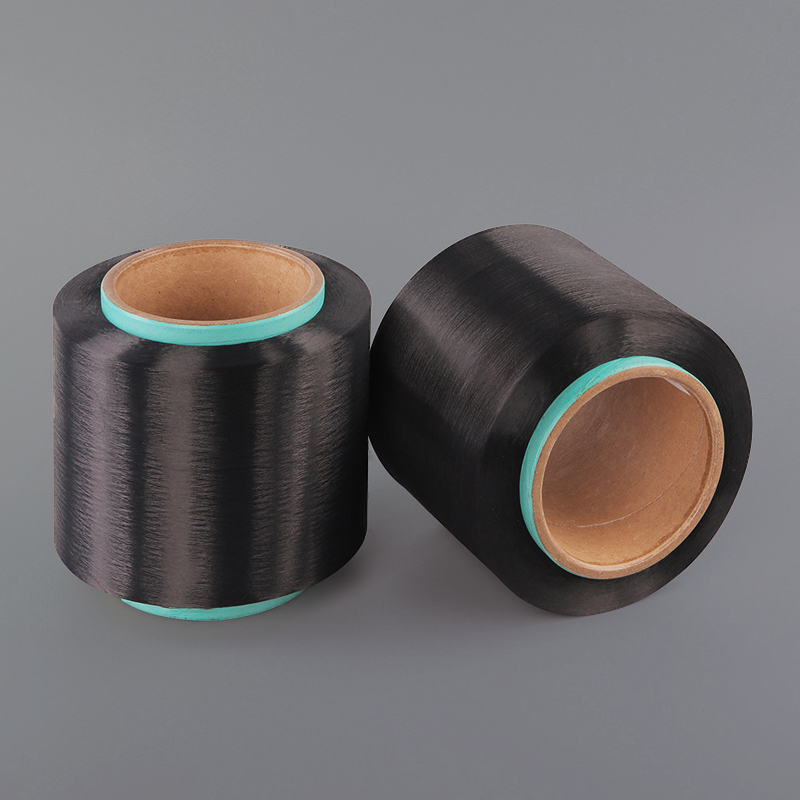
Anti Static Polyester Yarn Black
Conventional polyester is primarily selected for mechanical and aesthetic properties. It does not normally provide a dedicated pathway for static dissipation. Anti-static polyester yarn black adds a defined resistance value of 10⁶ Ω/cm, making it more appropriate for products where charge management is part of the specification.
This distinction is especially important when a fabric is used close to electronic components, sensitive instruments, combustible dust, or flammable atmospheres. Standard polyester may still be present in the same product, but the anti-static yarn provides a functional element that ordinary polyester cannot deliver on its own.
Many textile materials can be made temporarily less static through topical finishes, softeners, or moisture-attracting chemicals. These treatments may be economical for certain applications, but their performance can change after washing, dry cleaning, abrasion, or exposure to processing chemicals.
The anti-static polyester yarn described here is developed with specialized treatment technology and a fiber-focused functional design. The product information states that the fiber can maintain its static suppression performance after repeated washing. This provides an advantage for reusable clothing and industrial textiles that must retain performance throughout multiple service cycles.
Humidity-sensitive anti-static systems may perform well in a humid laboratory but lose effectiveness in a dry factory or winter climate. The low humidity dependence of this yarn helps provide a more consistent performance profile across different operating conditions.
For global textile producers, this can simplify product development. One yarn platform may be suitable for customers in several climate regions, reducing the need for separate material solutions based solely on seasonal humidity changes.
Because the product is a polyester FDY yarn, it can be integrated into familiar textile production systems. Manufacturers can use it in knitting, weaving, blending, and other filament-based fabric constructions. Existing polyester expertise, equipment, and finishing knowledge can often be applied with appropriate process trials.
This compatibility helps reduce the transition barrier compared with adopting a completely different fiber family. Manufacturers may retain the familiar advantages of polyester, such as strength, dimensional stability, easy care, and abrasion resistance, while adding anti-static functionality.
The availability of 20D, 40D, and 60D gives designers options for lightweight, medium-weight, and more substantial textile constructions. Fine 20D yarn can support light and flexible fabrics, while 40D and 60D can provide greater coverage or structural contribution depending on the fabric design.
Special counts can be produced by order. This is useful for customers who need a particular filament fineness, fabric weight, knitting gauge, cover factor, hand feel, or electrical performance. Custom production allows the yarn to be matched to a product concept instead of forcing the product concept to fit only standard specifications.
Anti-static textiles can be produced through several approaches. Some depend heavily on moisture absorption. Others use conductive coatings, metallic components, carbon-based elements, or inorganic additives. Each approach has a place, but the selection must consider flexibility, appearance, processability, durability, and cost.
Humidity-dependent solutions may provide satisfactory performance in controlled conditions but become less reliable when the air becomes dry. The low humidity dependence of this polyester yarn offers an advantage for products used across uncontrolled environments.
Metallic or carbon-containing fibers can provide strong conductivity, but they may affect color, softness, drape, surface appearance, or processing behavior. In some products, a highly conductive fiber is unnecessary; controlled static dissipation is sufficient. Black anti-static polyester yarn provides a practical option for applications that need a functional electrical property while maintaining a conventional filament textile format.
Topical coatings may alter the hand feel of a fabric and can be vulnerable to abrasion or laundering. A fiber-based functional approach can help maintain performance more consistently throughout the material’s life. The suitability of each method should be judged by the required electrical classification and final product testing, but this yarn offers a balanced alternative for many commercial textile applications.
The production of functional yarn requires more than simply spinning polyester into a filament. The material must be designed so that the electrical function, filament uniformity, mechanical behavior, color, and processing performance work together. GC FIBER’s product development approach is focused on special and functional textile materials, allowing anti-static performance to be considered alongside the practical requirements of textile manufacturing.
The first stage is the selection and preparation of the polyester system and the anti-static functional technology. The formulation must support the target resistance value while maintaining spinnability and filament integrity. If the functional component is not properly balanced, it may cause uneven extrusion, filament breakage, poor elongation, inconsistent color, or unstable electrical performance.
A well-designed formulation considers compatibility between the functional component and the polyester matrix. It also considers thermal behavior during melting, mixing, extrusion, spinning, and drawing. The objective is to distribute the functional property consistently through the yarn structure or create a stable functional region within the filament.
The supplied product information identifies advanced anti-static treatment technology and a low resistance design. These characteristics indicate that the anti-static function is addressed during product development rather than being treated as an incidental finishing effect. Such integration is important for long-term performance and production consistency.
During filament production, polymer material is heated to a controlled molten state and delivered through spinning equipment. The melt must remain stable and uniform as it passes through the extrusion system. Temperature control, pressure stability, filtration, and residence time all influence filament quality.
For a functional yarn, the process must protect the anti-static component from excessive thermal degradation while ensuring adequate dispersion. Stable extrusion supports consistent filament diameter, smooth surfaces, and predictable mechanical properties. These qualities directly affect downstream weaving and knitting efficiency.
Uniform extrusion is particularly important when the yarn is supplied in fine counts such as 20D. Small variations in filament diameter can influence tension, appearance, dye uptake, fabric density, and resistance measurement. Process control at the spinning stage therefore contributes to both the aesthetic and functional quality of the finished yarn.
After extrusion, the molten polymer is formed into continuous filaments. The filaments are cooled, solidified, and drawn to develop the desired molecular orientation and mechanical performance. In FDY production, drawing is completed as part of the manufacturing process so that the yarn can be delivered in a stable, ready-to-use form.
Drawing can improve tensile performance, dimensional stability, and uniformity. It must be controlled carefully because excessive or insufficient drawing can affect elongation, strength, crimp behavior, and fabric hand. For anti-static yarn, the drawing process must also preserve the distribution and continuity of the functional system.
Consistent FDY processing gives customers a yarn that is suitable for high-speed textile manufacturing. A stable yarn reduces issues such as uneven tension, filament separation, frequent end breaks, and fabric streaks. This contributes to productivity as well as product quality.
The black color of the yarn is important for end-use appearance and product identification. Color uniformity is managed alongside filament quality so that the yarn produces a consistent result in finished fabrics.
Black functional yarn may be used by itself or blended with other colors and fibers. In either case, the yarn should be evaluated for color compatibility, migration behavior, dyeing conditions, and visual consistency. Customers with precise color requirements can discuss the intended application and production conditions when requesting a quotation or custom count.
Electrical resistance is a central quality indicator for this product. The stated black yarn resistance is 10⁶ Ω/cm. Quality control should verify that the yarn meets the agreed specification using a consistent test method and defined conditioning environment.
Functional textile quality control normally combines electrical testing with physical and appearance checks. Depending on the order, these may include yarn count, tensile strength, elongation, winding quality, filament uniformity, color consistency, moisture content, and package appearance.
Testing at different production stages helps identify variation before the yarn reaches the customer. Batch-level monitoring also supports traceability and allows production teams to investigate any change in raw material, process condition, or finished performance.
Customers should confirm the exact test method, sample conditioning, acceptable tolerance, and reporting format before purchase. Resistance values can vary according to electrode configuration, sample length, contact pressure, temperature, humidity, and whether the test is performed on yarn or finished fabric. Clear technical communication ensures that supplier and customer evaluate performance on the same basis.
GC FIBER supports special production by order. This capability is valuable for technical textile companies that need a non-standard denier, a specific package format, or a yarn adapted to a particular weaving or knitting process.
Custom development generally begins with a review of the customer’s application, fabric structure, machinery, target resistance, count, quantity, color, and delivery schedule. Trial production may then be used to confirm processability and finished fabric performance. This cooperative model is more flexible than a catalogue-only supply system.
The company also cooperates with customers to develop new materials. Its broader product portfolio in biodegradable, low melting, ECDP, HDPE, biocomponent, and polyester filament yarns provides a foundation for discussions involving blended or multi-functional textile solutions.
Anti-static workwear is one of the most important applications. Garments worn in electronics production, precision assembly, laboratories, cleanrooms, and industrial facilities may need to reduce charge generation and accumulation. Anti-static yarn can be knitted or woven into shirts, jackets, trousers, coveralls, caps, gloves, and other clothing components.
The yarn can be used as part of a full anti-static fabric or blended strategically with ordinary textile yarns. The final garment design should consider seams, closures, accessories, footwear, grounding methods, and laundering instructions. Yarn selection is an important step, but complete garment performance must be validated as a system.
Electronic components and precision instruments can be sensitive to electrostatic discharge. In controlled manufacturing environments, textile materials must be selected carefully to minimize contamination and static-related risk.
Black anti-static polyester yarn is suitable for fabrics used in cleanroom garments and electronics workwear when combined with appropriate fabric construction and finishing. Its low humidity dependence is especially relevant in air-conditioned or dry production areas where static can increase.
Cleanroom customers may also require low-lint construction, controlled shedding, particle management, and compatibility with repeated industrial laundering. These requirements should be considered during fabric development and tested using the customer’s established procedures.
Static control is also important in petrochemical, chemical processing, powder handling, and dust-hazard environments. A spark caused by electrostatic discharge can create a serious risk where flammable vapors, gases, powders, or particles are present.
Anti-static yarn can contribute to protective fabric construction by reducing charge accumulation. However, yarn alone does not make a garment suitable for hazardous-area use. The complete textile, garment, accessories, footwear, grounding system, and applicable safety requirements must be evaluated. Manufacturers should select the yarn as one component of a certified or appropriately tested protective solution.
Automotive interiors can benefit from static-management properties in seat fabrics, carpets, headliners, door panels, and other textile-based components. Static charge may contribute to dust attraction, unpleasant discharge, or customer discomfort when entering or leaving a vehicle.
The yarn’s polyester base is compatible with the performance expectations commonly associated with automotive textiles, including durability, abrasion resistance, appearance retention, and dimensional stability. Automotive customers may also require resistance to light, heat, cleaning chemicals, fogging, odor, and flammability. These additional requirements should be tested separately for the complete material.
Anti-static yarn can be blended into standard polyester or other fiber systems to produce fabrics that combine comfort, appearance, durability, and static control. In knitted fabrics, the yarn can be incorporated into selected courses or wale arrangements. In woven fabrics, it can be inserted as warp, weft, or a designed grid according to the required electrical behavior.
The correct placement depends on the fabric’s use. A uniform distribution may be suitable for garments, while a patterned conductive grid may be more efficient for certain industrial textiles. Designers can adjust the blend ratio and fabric geometry to balance cost, softness, strength, conductivity, and visual effect.
Carpet, upholstery, curtains, office partitions, and interior textiles can accumulate static through foot traffic, friction, and contact with synthetic materials. This can be inconvenient in offices, server rooms, laboratories, commercial buildings, and other occupied spaces.
Anti-static polyester yarn helps reduce static charge in these products. It can be used in pile, backing, decorative fabric, or blended construction depending on the design. The final carpet or interior product should be evaluated for surface resistance, charge generation, wear, cleaning durability, and compatibility with flooring systems.
Anti-static textiles may also be used for packaging bags, covers, dust-proof cloths, equipment wraps, and protective components. These products can help reduce dust attraction and lower the likelihood of a static discharge near sensitive parts.
Packaging designers should consider whether the product requires dissipative, conductive, or shielding performance. Anti-static polyester yarn is an effective material option for static reduction, but the final packaging design must be matched to the sensitivity of the contents and the relevant handling environment.
Denier indicates the mass per unit length of a filament yarn. A lower denier generally produces a finer, lighter yarn, while a higher denier generally provides greater linear mass and can contribute more coverage or fabric substance. The correct choice depends on the final textile rather than on electrical performance alone.
20D yarn is appropriate for lightweight fabrics, fine knitted constructions, lining materials, thin workwear, and applications where softness and flexibility are priorities. It can be used where the designer wants anti-static functionality without adding significant bulk to the textile.
Fine yarn requires careful control during warping, knitting, and weaving. Machinery tension, guide condition, package quality, and processing speed should be adjusted to protect filament integrity.
40D offers a balanced option between lightness and structural contribution. It may suit shirts, uniforms, lightweight protective fabrics, sports-related textiles, automotive components, and general functional fabrics.
This count can be incorporated into fabrics that require a moderate level of coverage while retaining a comfortable hand. It may also be selected for blending with other yarns where the manufacturer needs a practical balance between cost, handle, appearance, and performance.
60D is suitable for more substantial fabric constructions, carpets, upholstery, workwear, protective textiles, and products requiring greater coverage or body. It can support durable fabrics designed for repeated use and more demanding service conditions.
As with every denier, the final performance depends on filament structure, fabric density, blend ratio, and finishing. A 60D yarn may be an appropriate starting point for heavier fabrics, but trials remain important before mass production.
Custom deniers are useful when standard options do not meet a product’s technical or aesthetic needs. A customer may require a finer yarn for a lightweight cleanroom garment, a heavier yarn for an industrial fabric, or a specific count that matches an existing production line.
When requesting a custom count, customers should provide the intended fabric type, machine gauge, yarn feed conditions, target fabric weight, resistance requirement, color, order quantity, and delivery expectation. This information allows the manufacturer to assess feasibility and recommend a suitable development route.
Anti-static polyester yarn can be used in weaving and knitting, but the process should be planned carefully. Yarn tension, package unwinding, friction, guide alignment, and machine speed all influence the quality of the final fabric.
Before production, the yarn should be inspected for package damage, contamination, uneven winding, and labeling accuracy. Trial runs can confirm whether the yarn unwinds smoothly and whether the intended fabric construction provides the desired appearance and electrical behavior.
In blended fabrics, the anti-static yarn may be used as a percentage of the total yarn content. The correct proportion depends on the target performance and fabric design. Using more yarn does not automatically guarantee better results, because excessive functional yarn can affect softness, cost, color, handle, or processing behavior.
Fabric finishing should also be reviewed. Heat setting, dyeing, coating, washing, calendaring, laminating, and chemical finishing may influence resistance and charge decay. The finished fabric should be tested after all major processes rather than relying only on the original yarn value.
Garment manufacturers should test the assembled product, including stitching thread, labels, elastic components, buttons, zippers, closures, and other accessories. A fabric may have good anti-static properties while the completed garment behaves differently because of construction or non-textile components.
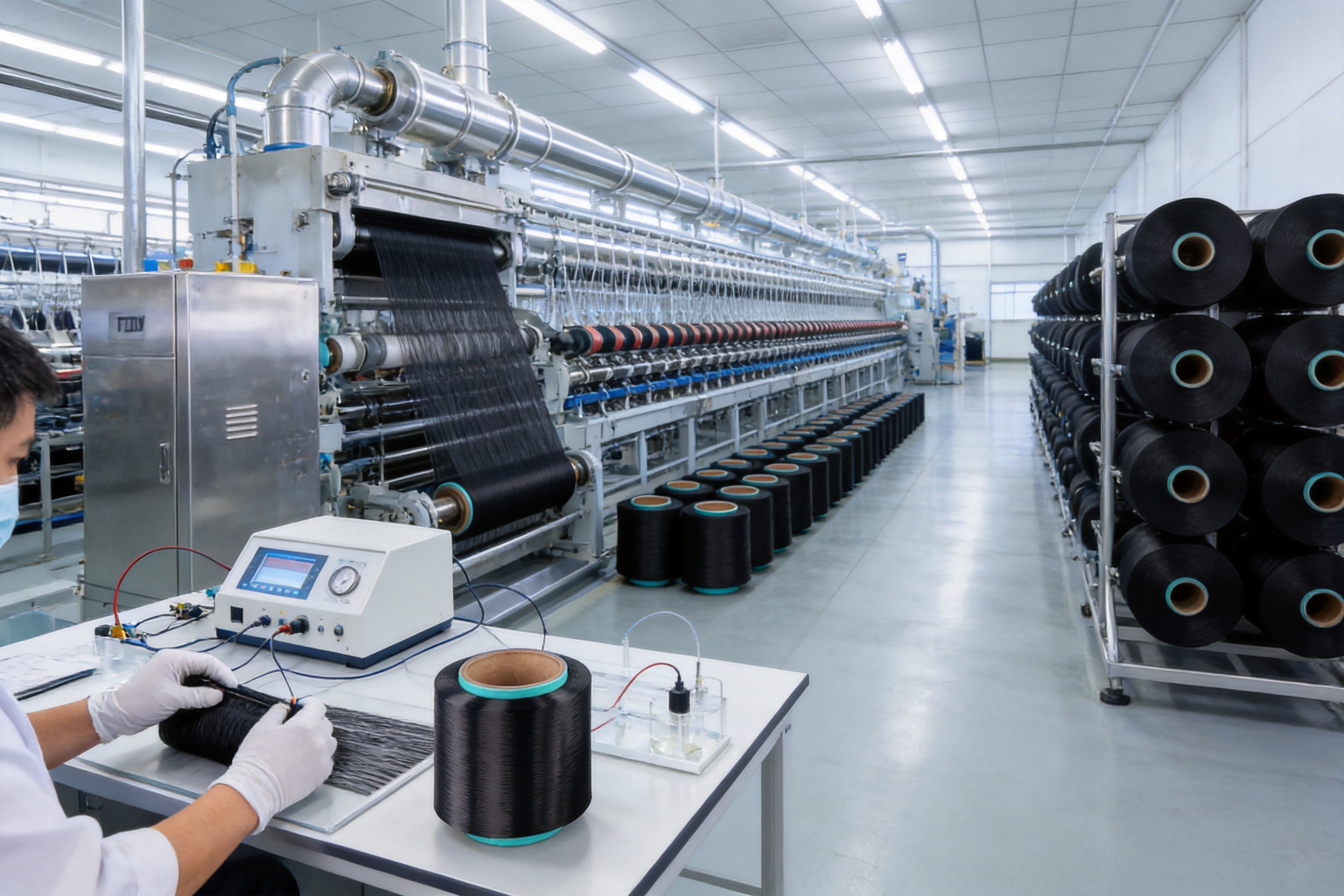
Reliability is essential for functional yarn because customers are not purchasing appearance alone. They are purchasing a measurable performance property that must remain useful during processing and service.
The product’s stated resistance value of 10⁶ Ω/cm provides a defined quality target. Maintaining this value under controlled production conditions requires attention to raw materials, functional component dispersion, spinning stability, drawing, package formation, and inspection.
Long-lasting anti-static performance is another major strength. The supplied product information indicates that repeated washing does not eliminate the static suppression effect. This is beneficial for uniforms, workwear, reusable cleanroom garments, carpets, and other textiles that are expected to survive multiple cleaning cycles.
Polyester’s inherent heat resistance also supports applications involving elevated processing or service temperatures. The anti-static yarn is designed to maintain a stable fiber structure under high-temperature conditions and resist deformation compared with less heat-stable alternatives. The exact temperature limit should be confirmed for each application and processing route.
Durability also contributes to lower total ownership cost. A yarn that retains its function for a longer period can reduce replacement frequency, re-treatment requirements, and performance complaints. For industrial buyers, this can be more important than the initial purchase price alone.
GC FIBER has operated as a special textile factory in China since 2006. Its stated business scope includes research, development, production, and sales of special and functional eco-friendly textile products. This combination is significant because technical yarn customers often need more than standard catalogue supply.
The company’s portfolio covers several specialized material categories. These include biodegradable yarn, low melting yarn, ECDP yarn, anti-static yarn, HDPE yarn, biocomponent yarn, and polyester filament yarn. Exposure to multiple fiber technologies can support cross-functional product development, especially when customers are seeking a combination of static control, sustainability, bonding, softness, strength, or thermal performance.
Research and development capability is particularly valuable for anti-static products. Static control is affected by fiber chemistry, yarn geometry, fabric construction, finishing, humidity, and end-use conditions. A manufacturer that works with functional materials can participate in solving the complete technical problem rather than supplying a generic filament without application support.
GC FIBER also cooperates with customers to develop new materials. This creates a pathway for customers with special requirements, including custom counts, unusual fabric structures, new blending concepts, and emerging technical textile applications.
Production flexibility is another advantage. Standard 20D, 40D, and 60D counts can address common requirements, while special counts can be produced to order. This combination allows customers to begin with established specifications or move toward a tailored product when necessary.
Logistics are supported through Shanghai Port, one of China’s major international shipping gateways. Shipment from Shanghai provides access to domestic and overseas trade routes and can support organized export planning for customers around the world. Delivery schedules remain dependent on order details, production planning, customs procedures, and freight conditions.
Anti-static polyester yarn is primarily a functional product, but it is part of a broader movement toward specialized and more responsible textile materials. Textile manufacturers increasingly want materials that solve a defined technical problem while improving resource efficiency, product life, and user safety.
Long-lasting performance can contribute to more durable products. If a garment or interior textile maintains its anti-static properties for a longer period, it may remain useful for more service cycles. Product durability can support reduced replacement and more efficient use of manufacturing resources.
GC FIBER’s wider product range includes biodegradable and biocomponent yarns, reflecting an interest in environmentally oriented material development. Anti-static polyester yarn itself should be evaluated according to the customer’s sustainability objectives, including polymer selection, production energy, service life, washing requirements, recycling pathway, and end-of-life treatment.
It is important to distinguish functional performance from environmental certification. The supplied information identifies the company’s focus on eco-friendly textile products, but customers requiring formal environmental claims should request the relevant technical documents, declarations, certifications, and test reports for the specific product and order.
Before purchasing anti-static polyester yarn black, buyers should define the final product and its technical conditions. Important information includes the yarn count, fabric type, knitting or weaving method, target resistance, blend ratio, color requirement, washing conditions, temperature exposure, chemical contact, and expected service life.
Buyers should also specify whether they need yarn-level resistance data, fabric-level test results, or complete garment performance testing. These are different stages of evaluation and should not be treated as interchangeable.
For standard requirements, 20D, 40D, and 60D provide convenient starting choices. For specialized projects, custom deniers can be discussed with the manufacturer. The customer should request sample quantities before placing a large order so that the material can be evaluated on the intended machinery.
Packaging and shipment details should be agreed in advance. The shipping port is Shanghai Port, China, while the manufacturing address is No. 66 Qiaogang Road, Haian, Nantong City, Jiangsu Province, China. Production lead time may vary according to whether the order uses a regular count or requires special production.
Technical communication should include the required resistance unit and test conditions. Buyers should avoid comparing values obtained through different methods without confirming the measurement basis. A clear specification helps prevent misunderstandings and supports consistent incoming inspection.
A practical evaluation begins with yarn inspection. Check the package condition, count, color, winding, surface appearance, and labeling. Any visible contamination, damaged package, or abnormal unwinding should be recorded.
The second stage is machine testing. Run the yarn through the intended knitting or weaving equipment under controlled conditions. Monitor tension, end breaks, lint, filament separation, and package performance. Compare the results with the customer’s ordinary polyester yarn.
The third stage is fabric testing. Measure fabric resistance, charge generation, charge decay, surface uniformity, and physical properties according to the application’s requirements. Testing should be performed after dyeing, finishing, washing, or other treatments that will be used in commercial production.
The fourth stage is product testing. For garments, evaluate the complete garment rather than only a fabric swatch. For carpets, test the finished construction after installation or simulated use when appropriate. For packaging, assess the finished bag, cover, or wrap under realistic handling conditions.
The final stage is durability evaluation. Subject the material to repeated laundering, abrasion, heat exposure, humidity changes, or chemical contact as required by the intended application. The purpose is to verify that the anti-static function remains adequate throughout the expected service life.
Anti-static yarn can contribute to electrostatic control, but it should not be described as a complete safety system without testing the finished product. In hazardous environments, the textile must be evaluated together with grounding, footwear, garment design, accessories, work procedures, and applicable regulations.
For cleanroom use, particle shedding, laundering, packaging, and garment construction may be as important as resistance. For electronics applications, charge decay and discharge behavior may need to be assessed in addition to resistance. For automotive interiors, flammability, aging, abrasion, and chemical resistance may be required.
Customers should identify the standards relevant to their market and application before finalizing the specification. The manufacturer can then discuss whether the yarn’s available technical data and sample testing are suitable for the project.
It is a black polyester filament yarn with specialized anti-static functionality. The product is supplied as FDY and is designed to reduce static accumulation in textile materials. The stated resistance value for the black yarn is 10⁶ Ω/cm.
Regular counts include 20D, 40D, and 60D. Special counts can be customized by order after reviewing the customer’s application, production process, target quantity, and technical requirements.
Yes. The yarn type is FDY, meaning fully drawn yarn. It is designed for use as a continuous filament yarn in suitable weaving, knitting, and textile production processes.
The product is designed to maintain its static suppression performance after repeated washing. Actual durability depends on the fabric structure, washing temperature, detergent, mechanical action, finishing, and service environment, so finished-product testing is recommended.
The anti-static effect is designed to have weak dependence on humidity. The yarn can continue to suppress static generation in low-humidity environments more effectively than many humidity-dependent solutions. Environmental testing should still be performed for critical applications.
Yes. It can be blended with standard polyester or other suitable textile fibers. The correct blend ratio depends on the desired electrical performance, fabric construction, cost, appearance, and hand feel. Trial production is recommended.
Typical applications include anti-static workwear, cleanroom garments, electronics manufacturing, semiconductor production, precision instruments, petrochemical and chemical protective fabrics, automotive interiors, carpets, office textiles, server-room textiles, packaging, and dust-control fabrics.
It may be used as one component of an anti-static protective textile, but the complete garment must meet the applicable safety and performance requirements. Yarn selection alone does not establish compliance for hazardous-area clothing.
The product is designed around a stable fiber-based anti-static function rather than relying only on a temporary surface treatment. This can support more durable performance after washing and use. The exact advantage should be confirmed through comparative testing under the customer’s conditions.
Yes. GC FIBER offers special counts and cooperates with customers on new material development. Customers should provide detailed information about count, fabric structure, machinery, resistance target, color, quantity, and application environment.
The listed shipping port is Shanghai Port, China. Delivery arrangements and lead times depend on the order specification, production mode, logistics plan, and destination.
Customers should test yarn count, appearance, winding, processability, resistance, fabric performance, laundering durability, humidity response, and the final product under realistic use conditions. The applicable industry or customer standards should guide the test program.
Anti-static polyester yarn black provides a practical way to add static-control functionality to polyester-based textiles. Its main advantages include a stated resistance value of 10⁶ Ω/cm, long-lasting performance after repeated washing, weak dependence on humidity, heat and water resistance, regular availability in 20D, 40D, and 60D, and the option of customized counts.
The product is especially suitable for workwear, cleanroom garments, electronics manufacturing, chemical and petrochemical protection, automotive interiors, carpets, packaging, and other functional textile applications. Compared with ordinary polyester, it offers a defined electrical function. Compared with temporary or humidity-dependent solutions, it is designed to provide more stable performance across washing cycles and dry environments.
GC FIBER strengthens this product offering through special textile research, functional material development, flexible production, customer cooperation, and a broad portfolio of advanced yarn categories. Its experience in producing specialized and environmentally oriented textile materials supports customers that need more than a standard filament yarn.
For the best result, buyers should evaluate the yarn in the complete fabric and product system. By combining the correct denier, fabric design, processing conditions, testing method, and end-use requirements, manufacturers can develop textiles that provide reliable static management while retaining the familiar advantages of polyester.
1. Product specification information for Anti-Static Polyester Yarn Black, including FDY construction, available deniers, resistance value, color, production mode, and shipping information.
2. Manufacturer information for GC FIBER and NanTong Global Chemical Fiber Co., Ltd., including company history, functional textile product categories, research and development activities, and customer material cooperation.
3. General principles of electrostatic generation, charge accumulation, resistance, humidity dependence, and static dissipation in textile materials.
4. General textile engineering principles relating to polyester filament spinning, fully drawn yarn production, drawing, weaving, knitting, blending, and fabric finishing.
5. General technical textile practices for evaluating anti-static fabrics, protective workwear, cleanroom garments, automotive interiors, carpets, packaging materials, and industrial textiles.
It is made with Bio-base PLA, fully biodegradable Feature: 1. Industrial compost product 2. Made with PLA 3. Eco-frie...
READ MOREPlease fill out the form below and our team will contact you as soon as possible.
Addres: No.66 Qiaogang Road, Haian, Nantong City, Jiangsu Province, China
E-mail: service@gcfiber.com admin@gcfiber.com
Copyright ? GC FIBER All Rights Reserved. Eco-Friendly Textile Products Manufacturer Biodegradable Yarn Company